The Climate Transition Plan (CTP) prepares your business for a world shaped by climate change – and turns regulatory pressure into a strategic competitive advantage. It serves as a binding roadmap: climate targets are backed by concrete reduction measures and business cases, responsibilities are clearly defined, and progress is made measurable. This keeps your climate strategy manageable – and adaptable as conditions evolve.
Regulatory requirements such as the Corporate Sustainability Reporting Directive (CSRD) demand far-reaching transparency on past, current, and future climate efforts. But the CTP goes well beyond compliance: banks are increasingly linking lending decisions to climate targets, investors require transparent decarbonisation pathways, and customers expect concrete action from their suppliers. Organisations that want to remain competitive in the long term need this tool – for internal governance, financial security, and lasting market relevance.


Climate targets without an implementation plan remain statements of intent. Organisations that develop a robust CTP early on not only meet growing regulatory requirements – they also lay the foundation for better financing conditions, stronger stakeholder relationships, and resilient corporate governance.
Meet regulatory requirements with confidence: The CSRD and other reporting frameworks require a credible Climate Transition Plan. A robust CTP ensures full compliance – and protects you from reputational and legal risks arising from missing or unconvincing climate disclosures.
Prioritise measures with precision: A CTP makes the business case for every decarbonisation measure tangible – based on investment requirements, payback periods, and CO₂ reduction potential. Resources flow where they deliver the greatest impact.
Strengthen investor and bank conversations: Banks and investors increasingly demand credible climate strategies. A robust CTP provides the data needed for a positive credit assessment and a strong ESG rating – ready to use in financing discussions.
For over 17 years, we have supported organisations in developing and implementing climate strategies. We combine expertise in emissions accounting, scenario analysis, financial planning, and governance – and deliver your CTP as a full-service provider: from the status quo analysis through to lasting integration into your processes.
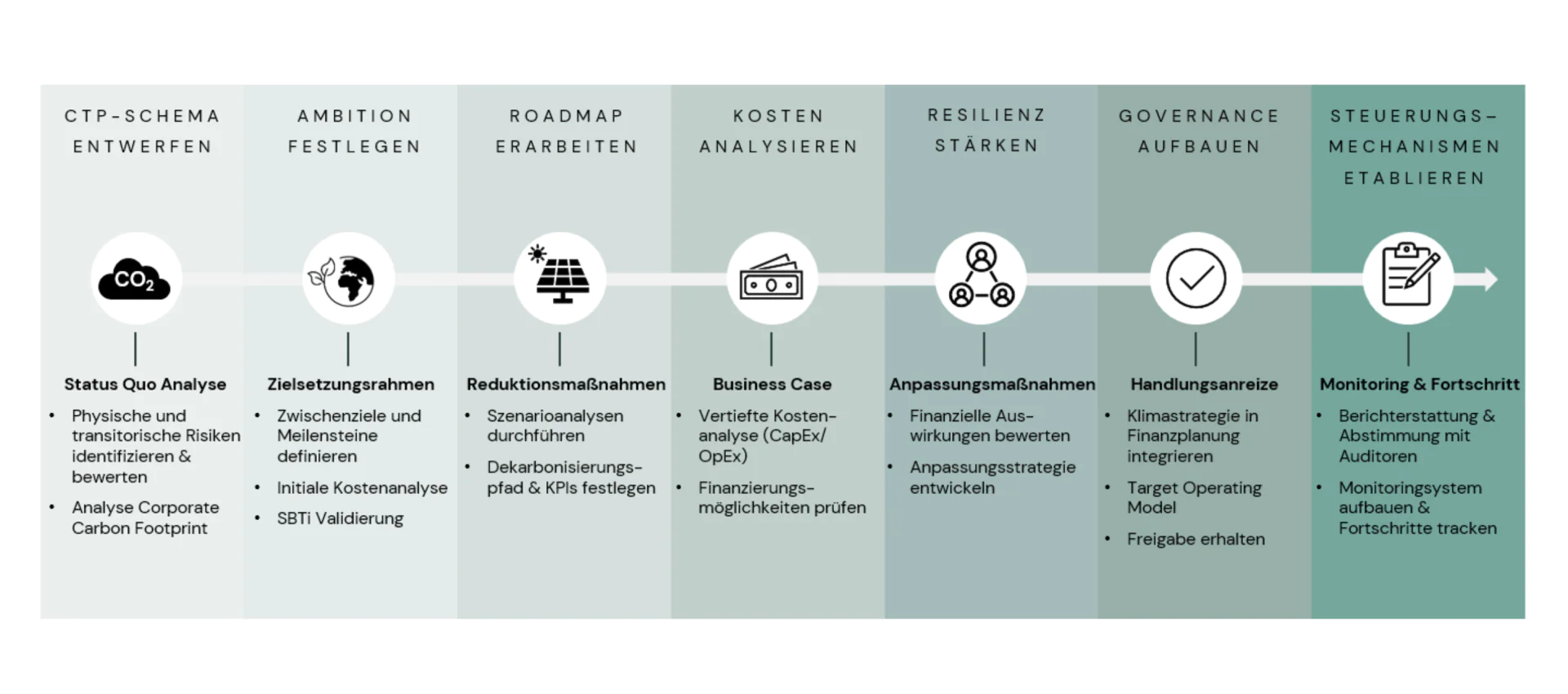
A thorough stocktake reveals where your organisation stands in its climate transition planning. The foundation consists of two central elements: a complete Corporate Carbon Footprint (CCF) calculation and a climate risk analysis. Using a standardised approach, we systematically identify gaps and action areas, and develop a time-bound milestone plan – tailored to your industry, your starting position, and your climate ambition.
Robust climate targets require a clear framework. We define science-based interim targets and milestones, conduct an initial cost analysis, and prepare target validations – for example through the Science Based Targets initiative (SBTi). This ensures your targets are ambitious, credible, and externally recognised.
Which levers have the greatest impact on your emissions? We identify and prioritise decarbonisation measures across your own operations (Scope 1 und 2) and throughout your value chain (Scope 3) – from quick wins to long-term transformation measures. Scenario analyses help define a robust decarbonisation pathway with measurable KPIs.
Transformation requires investment and a sound basis for decision-making. An in-depth cost analysis makes the business case for the CTP tangible: measures are prioritised by investment requirement, payback period, and CO₂ reduction potential. Building on this, we evaluate suitable financing instruments and assess options for equity and debt financing – including through internal carbon pricing.
Physical and transitional risks along the value chain – from rising CO₂ prices and regulatory requirements to production disruptions caused by extreme weather events or supply chain bottlenecks – are systematically captured in the CTP. Targeted adaptation and innovation measures actively reduce these risks and make your resilience visible to the outside world.
Successful implementation requires clear structures and continuous oversight. We develop a cross-functional implementation plan with defined roles, integrate the CTP into budget processes, and support the introduction of appropriate incentives – such as internal carbon pricing or sustainability-linked remuneration systems. We also help you prepare the key messages needed to secure formal board-level approval for your Climate Transition Plan.
Learn more about Targeting Operation Models.
A Climate Transition Plan only delivers results in implementation. We support you through this critical phase: from preparing materials for external stakeholders and CSRD-compliant reporting through to the audit process. A systematic monitoring system tracks progress, continuously identifies areas for improvement, and keeps responsibilities, costs, and timelines on course. This turns your CTP into a genuine management tool.


A CTP is more than a regulatory obligation. It structures climate activities, makes progress measurable, and distributes responsibilities durably across the organisation – regardless of whether a CSRD obligation applies. Sustainability becomes a strategic management tool that grows with your business, rather than a cost factor.

Banks are increasingly setting their own net-zero targets and are required to factor climate risks into lending decisions. A robust CTP improves your ESG rating structurally – not just at a single point in time – and opens lasting access to green finance instruments and sustainability-oriented investors.

Clients, suppliers, and business partners will increasingly expect climate transparency as a baseline. Organisations that establish a credible decarbonisation pathway today secure long-term market share, strengthen supplier relationships, and position themselves as trusted partners in a climate-conscious economy.


