Many organisations set ambitious climate targets – yet it is precisely in Scope 3 where they face the greatest challenges. Complex supply chains, indirect use-phase emissions, and wide-ranging interdependencies mean that emissions often rise rather than fall. Since direct access to and influence over these emission sources is limited, companies need new strategies.
Organisations face a dual challenge: they must not only identify suitable reduction measures, but also firmly embed these goals within their corporate structures and processes. Only then do one-off pilot projects evolve into lasting workflows that systematically encompass procurement, supplier management, product development, and customer communication.
Sustainable offers a holistic approach: we analyse your Scope 3 hotspots, develop effective and economical measures, and integrate these into governance, processes, and IT systems – so that your climate targets are achieved in a measurable, scalable, and lasting way.


Scope 3 emissions account for the majority of most organisations total greenhouse gas (GHG) footprint – and are simultaneously the most difficult to manage. Acting early secures competitive advantages, meets growing regulatory requirements (e.g. the Corporate Sustainability Reporting Directive (CSRD) and the Science Based Targets initiative (SBTi)), and strengthens the confidence of clients and investors.


We understand the sustainability challenges across a range of industries – including agriculture, mechanical engineering, and food retail – and deliver proven measures to reduce Scope 3 hotspots.

We integrate measures into the Target Operating Model (TOM), processes, and IT systems, ensuring that decarbonisation is standardised, scalable, and durably embedded.

Our interdisciplinary teams deliver well-founded emissions analyses and field-tested reduction pathways for measurable, economical Scope 3 results.
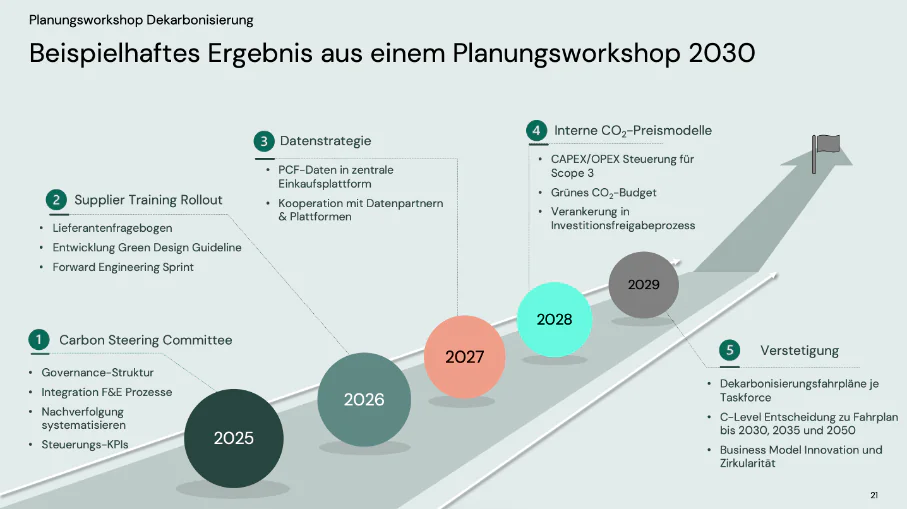
Our Scope 3 Decarbonisation Planning Workshop creates clarity and develops an individual company roadmap.