With the right instruments, processes and responsibilities.
Many organisations have set ambitious climate targets – yet the path from strategy to implementation remains the greatest challenge. What is often missing are clear accountabilities, the cascading of targets across business units, and effective governance instruments that embed climate action into decision-making processes.
At the same time, expectations are rising: the Corporate Sustainability Reporting Directive (CSRD), the Science Based Targets initiative (SBTi), and investors are increasingly demanding transparency on governance structures and decarbonisation progress. Robust climate governance bridges the gap between climate strategy and operational delivery. Organisations that build this foundation now will be equipped not just to set climate targets – but to actually achieve them.


Whether climate targets are achieved depends critically on how deeply sustainability and climate action are embedded within the organisation. Clear accountabilities, processes aligned with climate targets, the right governance instruments, and continuous monitoring are the key factors for effective climate management.
Many organisations face the same challenge: the climate strategy is defined – but how does it become operationally effective? Resistance to change, a lack of target cascading, and insufficient integration into existing processes all stand in the way. We guide you through the entire journey – from the initial assessment and selection of the right governance instruments to their lasting integration into your organisation.
We analyse your existing climate management processes and instruments, identify critical action areas, and conduct a hotspot analysis of relevant emission sources. From this, we derive priorities and unmanaged areas, and focus on the most material fields for action. Based on the current-state analysis, we jointly evaluate different governance instruments and outline feasible implementation approaches. The result: a well-founded decision basis with concrete recommendations for the instrument that best fits your organisation – whether Internal Carbon Pricing, Target Distribution, ESG-linked remuneration, or a hybrid approach.
Nearly half of the world's 500 largest companies already use an internal carbon price. We support you in developing and implementing a company-specific carbon price: from analysing relevant decision-making processes and conducting a benchmark analysis, to developing price scenarios and sensitivity analyses, through to process integration. This makes CO₂ a fixed factor in capital expenditure decisions, procurement, mergers & acquisitions, and risk management – while creating transparency on decarbonisation costs.
A company-wide climate target only delivers its full steering effect once it has been broken down across business units and operational levels. We develop the right target distribution framework with you: conducting an impact analysis based on identified emission hotspots, clustering your climate targets by business unit, and translating them into actionable KPIs – from product development and sales through to procurement. The result: concrete target distribution mechanisms that are manageable at the operational level.
Without robust monitoring, climate measures run unmanaged – and climate targets risk being missed. We develop a tailored KPI catalogue that makes your climate targets measurable and trackable. Building on this, we establish a monitoring system for the continuous tracking of defined KPIs and the identification of further reduction measures. Clear accountabilities and defined processes ensure that performance data is regularly collected, assessed, and used to inform steering decisions.
Climate targets belong where decisions are made – as growing capital market requirements make clear. We support you in designing an ESG-linked remuneration system: from a current-state analysis of your existing remuneration model and the definition of material ESG targets and KPIs, through to a fit-for-purpose design. This strengthens your ESG performance, your credibility, and your access to capital markets.
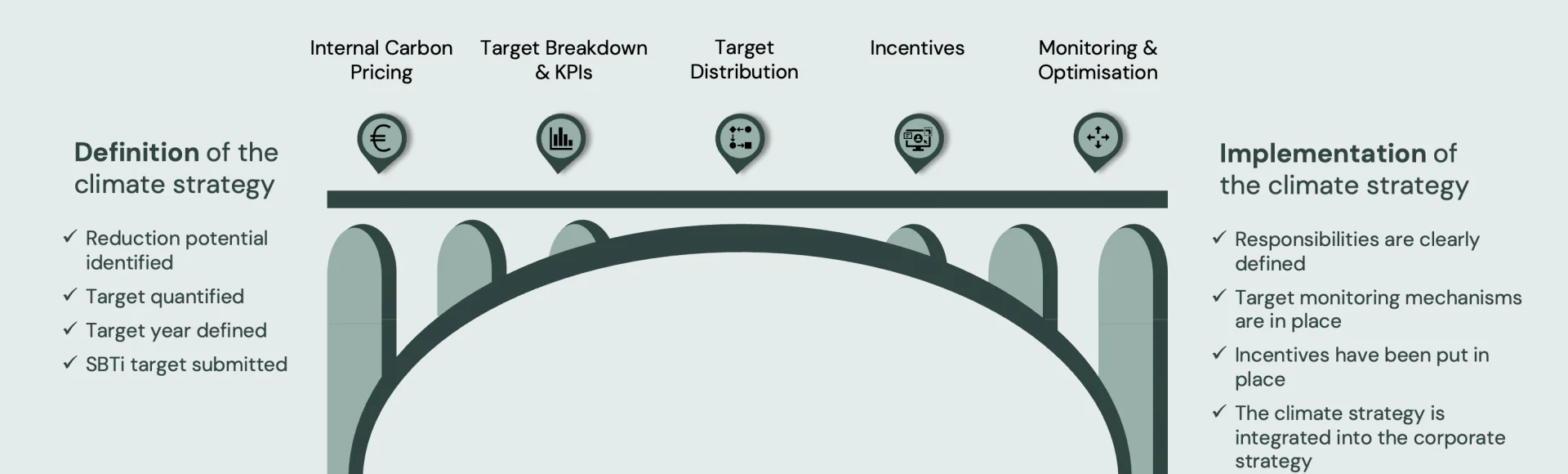


Organisations that systematically apply target distribution, monitoring, and governance instruments reduce their emissions measurably faster and more efficiently. Climate governance translates ambitious targets into manageable processes – and makes progress visible.
Learn more about Climate Strategy, Greenhouse Gas Accounting and Corporate Strategy.

A robust governance structure with integrated KPIs, Internal Carbon Pricing, and ESG-linked remuneration strengthens credibility with investors, rating agencies, and clients. At the same time, it provides the foundation for CSRD-compliant reporting on governance structures.

The outcomes of governance work form the basis for integrating climate aspects durably into internal risk management – with clear processes, accountabilities, and a reliable data foundation for business planning and reporting.


