Products and services are at the heart of your organisation – and at the same time the most powerful lever for sustainable business success. They determine the impact your company has on the environment and society: in production and across the entire lifecycle.
Organisations today face a threefold pressure: competition is intensifying, regulation is increasing, and customers, investors, and business partners are demanding measurable sustainability performance.
Those who act now can turn product sustainability from an obligation into a real competitive advantage – through reliable product data, optimised designs, a future-proof portfolio, and new business models. Those who wait risk market exclusions, rising costs, and reputational damage.


Our consulting services guide you along a clearly structured journey – from first transparency about your products through to new, future-proof business models. Each pillar builds on the previous one and creates tangible business value. Ensuring compliance is not an afterthought, but a continuous cross-cutting theme throughout.
A sustainable product strategy starts with data transparency. We collect and document all relevant sustainability data across the entire supply chain – from raw materials through production and transport to disposal. We apply established methods such as Product Carbon Footprinting (PCF), Life Cycle Assessment (LCA), and Environmental Product Declarations (EPD) on the basis of a consistent methodology. We also link assessment methods with data strategies and tool selection.
The result: for the first time, you know exactly which products leave which environmental footprints, where the greatest risks in the supply chain lie, and which products in your portfolio can be strategically enhanced.
Based on the data gathered, we identify targeted optimisation potential: Which materials can be reduced or substituted? Where can manufacturing processes be made more efficient? How can product design become more sustainable and cost-effective at the same time? We identify opportunities to advance product design and development processes – with a central focus on enabling your organisation to act independently.
This creates a dual benefit: organisations reduce their production costs while simultaneously increasing the appeal of their products to demanding customer segments that require reduced environmental impact.
Not all products share the same sustainability and profitability profile. We analyse your entire portfolio: Which products generate high sustainability costs alongside weak margins? Which sustainable variants are growing above average? We develop a tailored method for portfolio segmentation and derive a clear portfolio strategy from it.
We also design a customer engagement strategy: How do we communicate sustainable product benefits convincingly to different target groups? Sustainably marketed products grow on average twice as fast as conventional ones – we help you unlock that potential.
The most far-reaching transformation occurs when organisations rethink their business model entirely. We support you in developing digital, circular, and service-based business models: take-back and refurbishment programmes, leasing and usage models, or new product lines based on secondary raw materials. Our innovation approach "Sustainovation" combines sustainability expertise with entrepreneurial innovation.
These models not only open up new revenue streams – they also reduce dependence on volatile raw material markets and create secure internal material sources.
Compliance runs through all four pillars of the product strategy journey. We support you in preparing for current and upcoming regulations: Packaging and Packaging Waste Regulation (PPWR) compliance mapping and implementation, Ecodesign for Sustainable Products Regulation (ESPR) compliance mapping, Digital Product Passport (DPP) readiness and roadmap, as well as EmpCo-compliant communication.
Early, integrated compliance planning avoids costly last-minute implementations: organisations that systematically centralise compliance processes reduce their administrative costs significantly. Proactive measures are consistently more cost-effective than reactive adjustments.
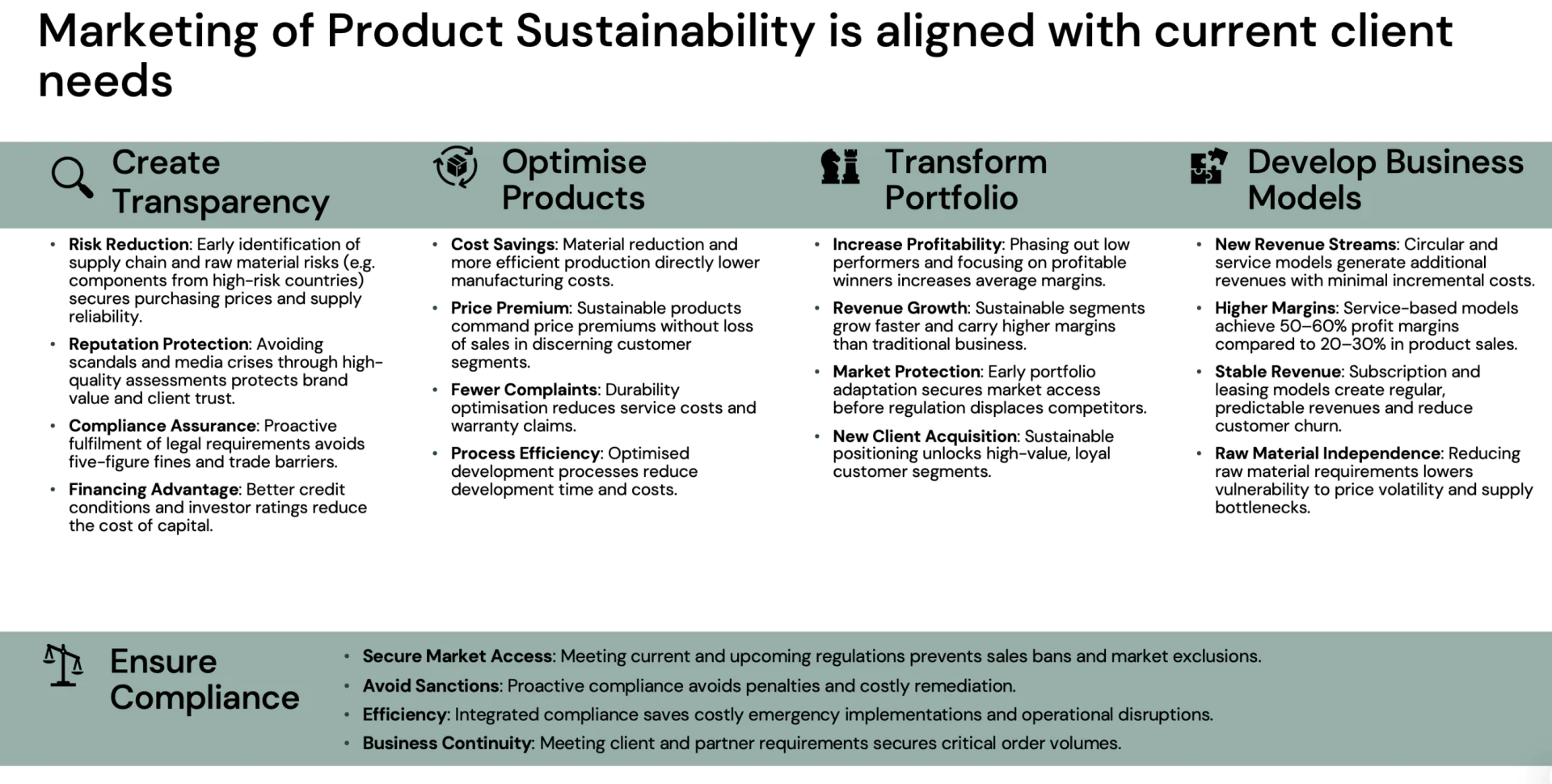


Integrating all five pillars reduces material costs, increases margins, and unlocks new revenue streams. Risk costs from compliance, reputation, and supply chain disruptions are systematically reduced – and sustainably positioned organisations benefit from better financing conditions.

Those who act today will meet upcoming requirements – DPP, ESPR, PPWR – without last-minute implementations, securing market access, supplier relationships, and customer trust. The real value lies in the ability to respond to new requirements faster than the competition.

By building internal processes, clear methodologies, and trained teams, product sustainability becomes a lasting core competency of your organisation. You reduce external dependencies and create the foundation for continuous improvement.


