By 2030, the Digital Product Passport (DPP) will become mandatory for many products in accordance with the European Ecodesign Directive. The DPP is a new digital information system designed to promote sustainable products through transparency. Specifically, this means that manufacturers must provide stakeholders in the value chain with information on recyclability, reparability, and CO2footprints. The EU will specify the exact requirements through so-called delegated acts in the coming years.
This poses major challenges for companies: Where does the data come from? How do I manage it, and how do I communicate it to my stakeholders?
Much of this information is currently difficult to obtain or simply unavailable. The required CO₂ data and material specifications are often only available at the company level, not at the product level.


To successfully implement the DPP, you need robust data management and a reliable infrastructure. This requires forward-looking planning of requirements and integration with other areas of ESG data management.
The requirements are complex, but achievable. We support you in preparing forand implementing the Digital Product Passport. Starting with a gap analysis, through strategic planning, to the detailed development of the necessary data and the implementation of IT systems for execution. We guideyou safely through thesenew regulatory and technical requirements and help you capitalize on real business opportunities.
Understand what the introduction of the DPP will mean for your company, how prepared you currently are, and what steps are necessary to obtain a pass for your products.
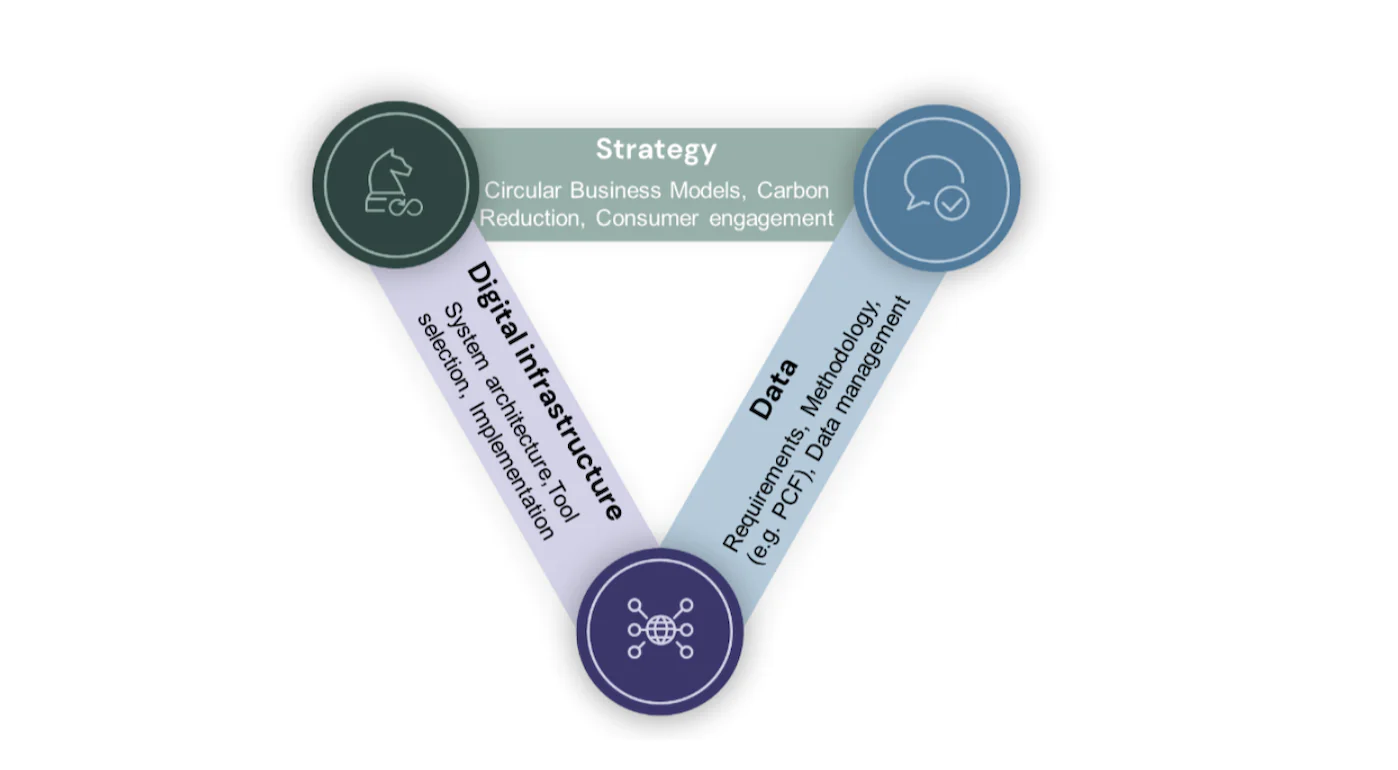
We conduct a detailed gap analysis: We review your current data against DPP/ESPR requirements and assess your existing data governance and digital infrastructure. The result is a systematic overview of the necessary steps for further preparation.
Transparency and points of interaction along the value chain open up new opportunities. Together, we’ll map out your ecosystem and use innovation methods to develop concrete approaches for DPP opportunities for your company. We’ll calculate business cases and develop a strategy for how youcan leverage the regulation to gain competitive advantages and capitalize on market opportunities.
A robust DPP architecture integrates data requirements, the IT system landscape, and the right tools—to ensure compliance and drive value creation. We support you every step of the way, from defining requirements and selecting tools to implementation. In doing so, we integrate ESG data management requirements and digital business models to create a future-proof, interconnected system within your organization.
Based on the current state of data available within your organization, we enable you to calculate, collect, or request the relevant data for the DPP with high quality. This includes life cycle assessments (LCAs), CO2footprints, and interaction with Suppliers. The focus is on information from the upstream supply chain. Where possible and appropriate, we use tool-supported and automated processes.



We have been assisting our clients for years with the calculation and collection of environmental and social data.

We have the solutions to help you set up ESG data management and utilization in an efficient and forward-looking way.

We analyze your data to identify opportunities for product development and new business opportunities.


